
The Fragile Future of Our Sea Turtles
By Dr Jane Barker
For over a hundred million years sea turtles have swum in the world’s oceans. Today, with little evolutionary change, there are seven species of turtle in the world and six can be found in Australia. Here, in Northern NSW, there are three varieties that are brought into the Australian Seabird and Turtle Rescue in Ballina - the Green Turtle, the Loggerhead Turtle and the Hawksbill Turtle, with the Green being the most commonly seen.
Despite being a protected species turtle numbers are falling. Hawksbill Turtles are classified as critically endangered, Loggerhead Turtles as vulnerable and Green Sea Turtles are currently listed as of least concern for now, having been removed from the endangered list in 2025. In the past, Hawksbill numbers were affected by hunting for their exotic shells. It is not natural predators that are causing this decline but the impact of humans on the Earth, particularly over the last century.
“The impact of humans on our turtle population is sadly readily apparent in the animals brought into our centre.” - Jen Slape, Assistant General Manager, Australian Seabird and Turtle Rescue
We need to understand how to prevent further decimation of our turtles and to understand their lifecycle and breeding patterns.
At each stage in their lives the sea turtle is vulnerable. They are particularly vulnerable to the impact of humans. We can make choices to reduce harm through changing our own habits and through legislation and if we don’t these beautiful gentle creatures may, after surviving for millions of years, become extinct.
Turtle shells
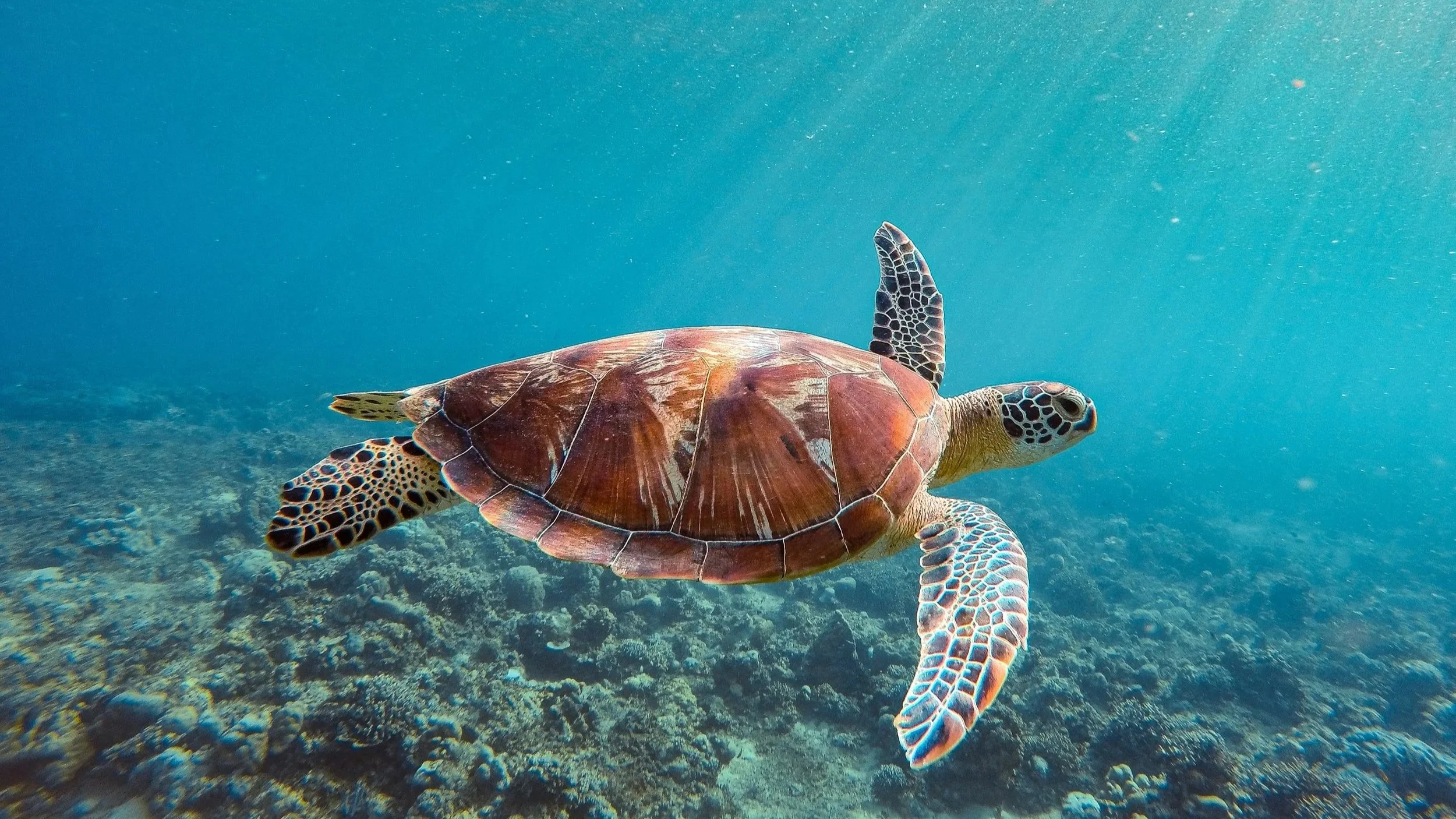
Turtles are unique for their strong protective shells, and the shell is probably why this species has survived and why sea turtles can live for 70 to 80 years. Unlike the domed shell of the land tortoise, the sea turtle shell is more streamlined for swimming. The shell of a sea turtle has an inner bony layer, the carapace above and the plastron below, and these are fused together. The top of the shell is covered by keratinous scutes. The marking on the carapace distinguishes between breeds and the turtles themselves. The bony part of the shell grows with the turtle and being fused to the spine and ribs forms part of the turtle skeleton. The scutes on the turtles’ back are shed regularly to allow for growth and to get rid of barnacles and algae. When it is time for shedding the turtle will rub its shell against rocks, reefs and the sea bottom.
The shell protects against predators and protects the spinal cord and vital organs which lie beneath it. If the turtle is hit by a boat the shell may fracture, damaging the spine and the organs it protects.
Swimming
The turtle hind and forelimbs have been adapted for swimming. While they usually cruise along at 1-2.5 kilometres an hour, if threatened they can move at 35 kilometres an hour. Turtle limbs are vulnerable to shark attacks and also by fishing gear. A turtle hit by a propellor and caught in netting can damage a limb which may become infected, and loss of a limb compromises speed when it is needed.
“There has been a rise in hook and line ingestion and entanglements in both marine turtles and seabirds and shorebirds.”
Breathing
Turtles need air to survive. An active turtle surfaces every 5-19 minutes, but the Green Turtle if resting slows its heart and metabolism and can stay submerged for up to 5 hours. Then the blood from the heart bypasses the lungs. The turtle breathes using specialised muscles which allow air to be drawn into expanded lungs and expel as the lungs contract. Should the turtle be held down, for instance by the weight of barnacles or being trapped in a ghost net, it will die from lack of air.
Feeding
The Green turtles diet changes with age. Hatchlings are omnivorous feeding on jelly fish, crustaceans and plants, but mature Green Turtles are wholly herbivorous, feeding on sea grass and algae, chewing off vegetation with their serrated jaws. They are named Green Turtles because of the colour of their fat due their green diet. Damage to seagrass beds due to ocean trawling, pollution or climate change can drastically affect their diet.
“Currently, the most prominent human impact on our marine turtles is climate change and how habitats and foraging grounds are affected by severe weather systems.”
Migration
Sea turtles are known for their migratory habits, moving between the beach of their birth where females will return to lay eggs to their favoured foraging grounds. Tagged turtles from the east coast of Australia travel to Indonesia, Papua New Guinea, Solomon Islands, Vanuatu , Fiji and New Caledonia. Green Turtle monitoring has shown they make journeys of 2,500 kilometres, the longest being recorded around 4,000 kilometres.
Turtles use magnetic field sensing to navigate in open waters. Yoshi , a Leatherback Turtle who was released from captivity in a Capetown aquarium swam across the Indian Ocean to Australia, an astonishing trip of 37,000 kilometres over 26 months.
Yoshi , a Leatherback Turtle who was released from captivity in a Capetown aquarium swam across the Indian Ocean to Australia, an astonishing trip of 37,000 kilometres over 26 months.
Lifespan
It is estimated that only 1:1000 hatchlings survive to maturity, but once they have braved the initial predators a turtle in the wild may live for up to 100 years with an average 70-80 in ideal conditions.
Reproduction
Green Turtles reach sexual maturity between 30-50 years so their survival to this age is imperative for the survival of the species. While hatchlings have many natural predators, the adults are well protected by the shell and natural predators are limited. This cannot be said for the human impact which can occur at any age and can be devastating.
Laying
Female sea turtles return from their foraging grounds, which may be several thousand kilometres away, to the beach where they were born to lay their eggs. Here in the ocean closer to shore, she mates with one or more male turtles. The female turtle has specialised tubules which allows her to store sperm. This means she does not need to repeat the mating process before laying each batch of eggs.
Usually at night she lumbers up the beach to find the ideal area of sand to make her nest, then using her back flippers she proceeds to dig a large hole. Into this she deposits around 100-150 fertilised eggs, each the size of a ping-pong ball. She then fills the hole in as effectively as she can with her flippers. The turtle does not wait to protect her nest or to nourish her young. As soon as she can, she returns to the safety of the ocean. A female will generally nest every 3 - 4 years and usually lay 4 to 5 times during that summer breeding season. With 330 eggs per nesting season, this is 1900-2300 eggs in a lifetime.
The eggs may be eaten by feral pigs, dingoes, goannas and foxes and form part of the traditional diet of Indigenous populations across the globe.
Hatching
Green Turtle eggs take around 60 days to hatch, though they hatch earlier the warmer the sand. Sand temperature changes with global warming are thought not only to cause hatchlings to be less robust and therefore more vulnerable when they hatch, but have a significant effect on the male to female ration. In Queensland where it is warmer the incubation period is 60 days, whereas here in NSW its 90 days due to cooler temperatures. In one Queensland study, 99% of turtles being females. This in itself puts the species in danger.
Once hatched the tiny turtles need to make their way across the beach into the ocean. Here they are prey to seabirds and ghost crabs. Even if they reach the ocean they are not safe, with all forms of sea life hunting them. It has been estimated that 1 in 1000 hatchlings survive to reach adulthood.
“Each release is just as memorable and rewarding as the next. The greatest reward is having the privilege of seeing each patient transform - in some cases from being deathly unwell - to having a second chance at life.”
At each stage in their lives the sea turtle is vulnerable. They are particularly vulnerable to the impact of humans. We can make choices to reduce harm through changing our own habits and through legislation and if we don’t these beautiful gentle creatures may, after surviving for millions of years, become extinct.
Get involved or donate to Australian Seabird and Turtle Rescue.